Let’s get straight to the point: While Botox is a household name for fighting wrinkles, it’s rarely the best solution for nasolabial folds. These 'smile lines' are almost always caused by a loss of volume and the skin starting to sag—structural issues that Botox, a muscle relaxer, simply isn't designed to fix.
Why Dermal Fillers Outperform Botox for Smile Lines
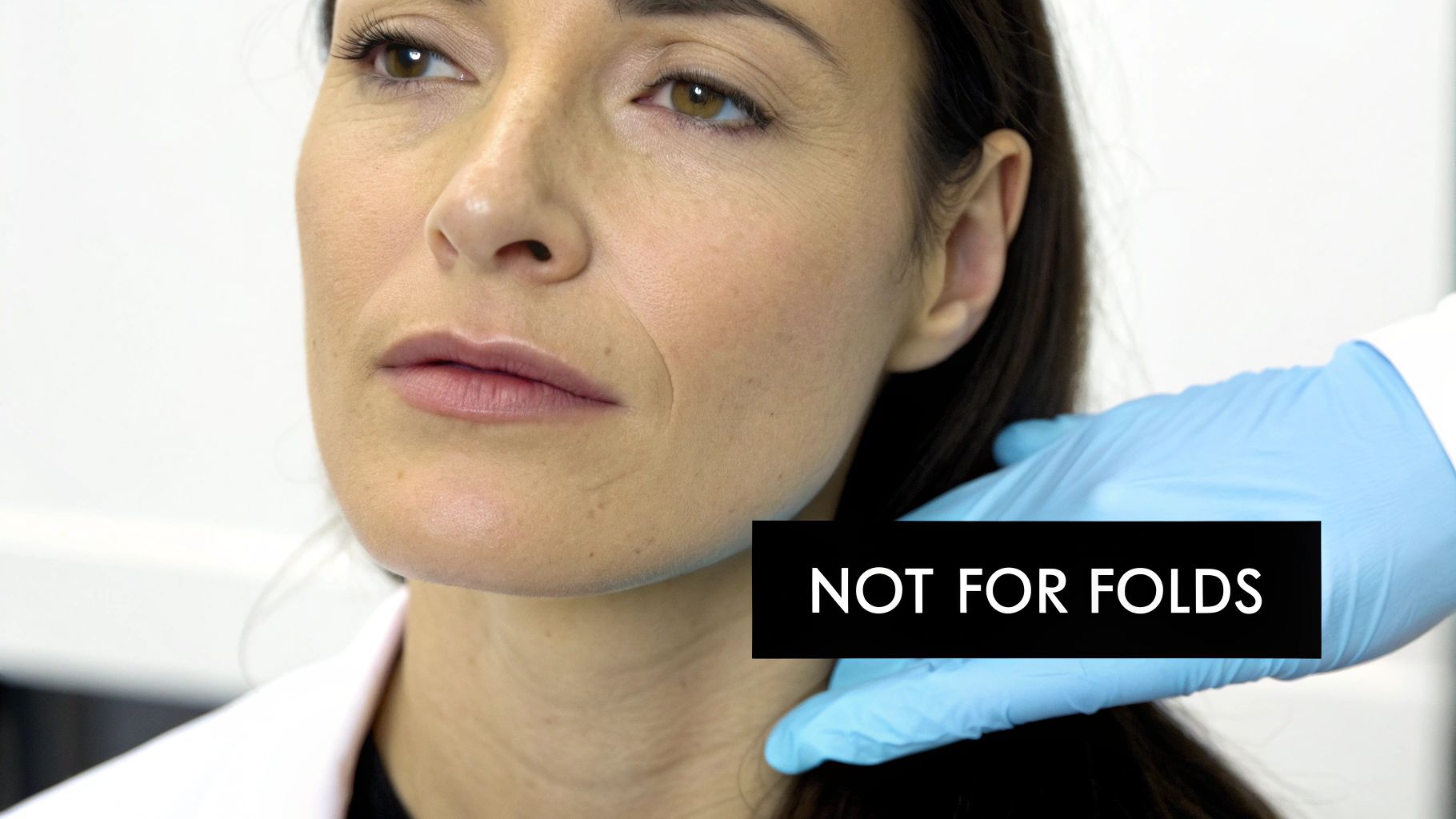
Many people search for "nasolabial folds botox" hoping for a quick fix, but this common misconception often leads to disappointment. Think of it this way: trying to treat a nasolabial fold with Botox is like trying to patch a pothole with paint. It might momentarily smooth the surface expression, but it does absolutely nothing to solve the underlying structural problem.
The real reason smile lines become more prominent isn’t because of an overactive muscle. It’s a combination of factors that happen over time:
- Volume Loss: The natural fat pads in our cheeks start to diminish and descend as we age.
- Skin Laxity: Our skin produces less collagen and elastin, losing the firmness that once kept everything lifted and tight.
- Facial Anatomy: We all have a natural crease that runs from the nose to the mouth, and it deepens as the structures above it lose support.
Botox works by temporarily relaxing muscles to smooth out dynamic wrinkles—those lines formed by expressions like frowning or squinting. You can explore our guide on common Botox injection sites to see where it truly shines. But nasolabial folds are typically static lines, meaning they’re visible even when your face is perfectly still. They need filling, not freezing.
Botox vs Dermal Fillers for Smile Lines at a Glance
For most people, the most effective treatment for restoring volume and lifting the skin around the mouth is a dermal filler, usually one made from hyaluronic acid. It directly addresses the root cause of the problem.
To make it crystal clear, here’s a quick comparison of the two treatments when it comes to smile lines.
| Feature | Botox (Botulinum Toxin) | Dermal Fillers (Hyaluronic Acid) |
|---|---|---|
| Primary Action | Relaxes muscles to soften expression lines | Adds volume and structure to lift and fill skin |
| Best For | Dynamic wrinkles (crow's feet, frown lines) | Static lines and volume loss (nasolabial folds) |
| Mechanism | Temporarily blocks nerve signals to muscles | Physically fills in hollows and deep creases |
Essentially, fillers rebuild the support your skin has lost, physically lifting the fold from underneath. Botox just can’t do that.
In the UK, Botox is still one of the most popular cosmetic treatments, with an estimated 449,000 treatments recorded between May 2024 and April 2025. However, when it comes to nasolabial folds, experienced practitioners almost always recommend fillers because they tackle the actual cause—volume loss—head-on.
Why Botox Isn't the Answer for Deeper Smile Lines
To get why Botox is rarely the right choice for nasolabial folds, you first have to understand what it’s actually designed to do. Think of Botox as a dimmer switch for overactive facial muscles. It works by temporarily blocking the nerve signals that tell a muscle to contract, forcing it to relax.
This is exactly why it works so brilliantly on dynamic wrinkles—the lines etched into your skin from repeated expressions. Crow’s feet from smiling, the ‘11s’ between your brows from frowning—Botox smooths these out by quieting the muscle beneath. It stops the skin from constantly creasing.
But nasolabial folds are a completely different beast. They aren't simple creases; they're more like valleys in your facial landscape. These folds don't show up because a muscle is working too hard. They deepen over time because of major structural shifts happening beneath the skin.
The Real Reason Nasolabial Folds Appear
The true culprits behind prominent smile lines are volume loss and good old gravity. As we age, a few key things happen:
- Your Cheek Fat Pads Drop: The little pockets of fat high on our cheeks (malar fat pads) start to shrink and slide downwards.
- Collagen Production Nosedives: Your skin’s scaffolding—collagen and elastin—breaks down faster than you can make it, leading to sagging and laxity.
- Bone Structure Changes: Even your underlying facial bones subtly change, offering less support for the soft tissue on top.
This combination of factors causes the skin of your mid-face to droop, deepening that natural groove running from your nose to your mouth. Trying to fix this with nasolabial folds botox is like trying to fix a saggy mattress by ironing the bedsheets—it does absolutely nothing to solve the underlying structural problem.
Injecting Botox near the mouth to treat smile lines isn't just ineffective; it can actually backfire. Weakening the muscles you need for normal facial expressions can lead to an unnatural or lopsided smile.
A Classic Case of Wrong Tool for the Job
It all comes down to using the right tool for the right task. You wouldn't use a screwdriver to hammer in a nail. In the same way, using a muscle relaxant (Botox) to fix a problem of lost volume (nasolabial folds) is a fundamental mismatch.
Because these folds are static—meaning they’re visible even when your face is perfectly still—they need a solution that physically props up the skin and restores that lost structure. This is where treatments like dermal fillers shine. They work by directly adding back volume under the skin, lifting the fold from within to rebuild a smoother, more youthful contour.
So, while the idea of using Botox for nasolabial folds is a common query, it stems from a misunderstanding of what causes them. For results that actually work and look completely natural, addressing the volume loss is the only way to go.
Introducing the Gold Standard: Dermal Fillers
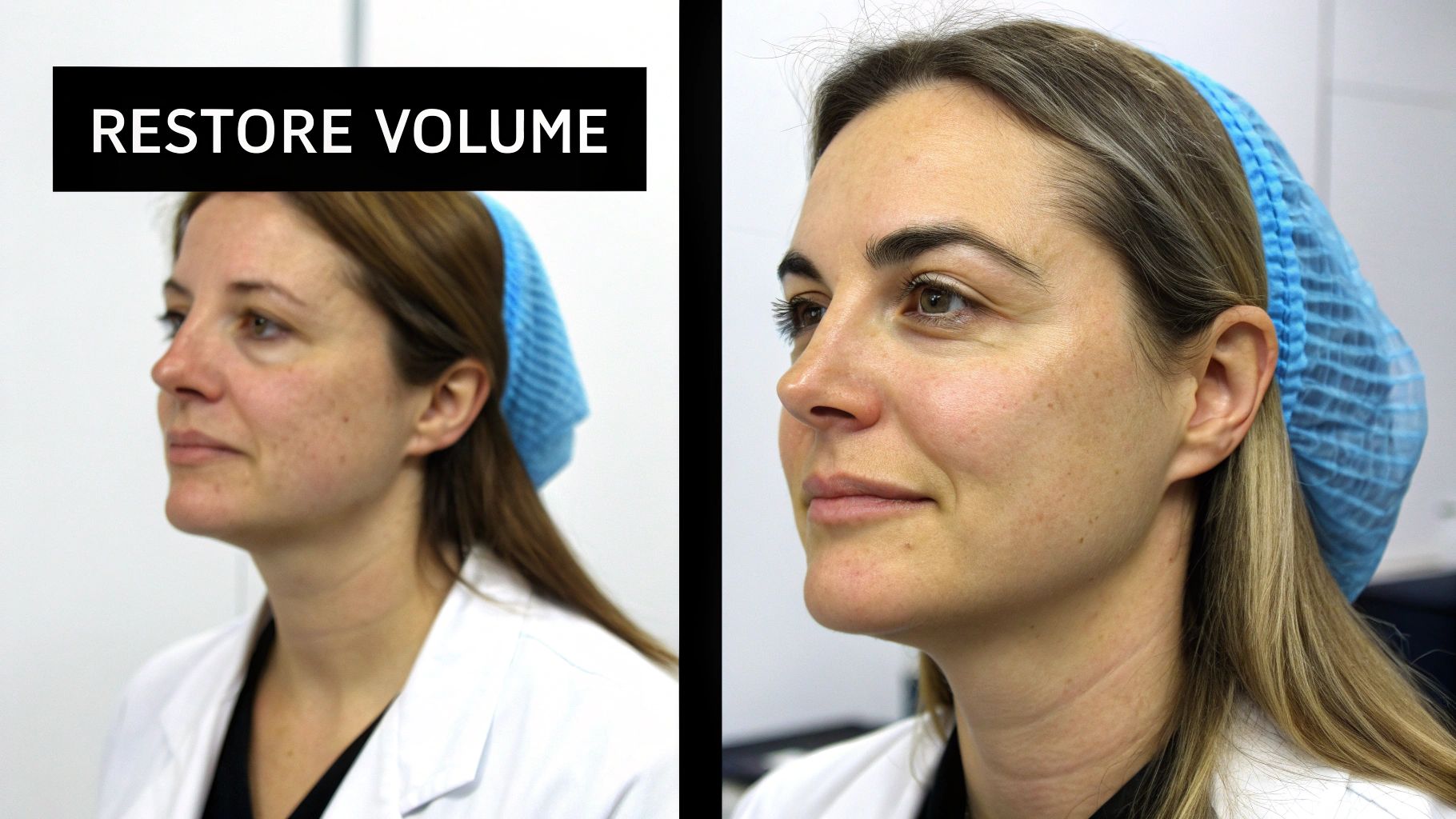
Since Botox works on muscles, not volume, we need a different approach for smile lines—one that gets to the root cause of the issue. This is where dermal fillers come in. They are, without a doubt, the gold standard for treating nasolabial folds.
Think of it like this: if a cushion has gone flat and the fabric on top has creased, you wouldn’t try to fix it by paralysing the fabric. You’d plump up the cushion from underneath. That’s exactly what hyaluronic acid (HA) fillers do for your skin. They’re specifically designed to restore lost volume right where it’s needed most.
This allows a skilled practitioner to physically lift the skin, smooth out the crease, and bring back a more youthful, supported contour to your mid-face. The result is immediate, looks completely natural, and actually fixes the structural problem.
The Dermal Filler Treatment Journey
Getting dermal fillers is far more than just a quick injection. It's an art form that requires a deep understanding of facial anatomy to create results that are balanced and beautiful.
Your practitioner will carefully assess your face, mapping out the precise points where adding a touch of volume will create the best lift and support. This strategic placement is everything.
Interestingly, the best results often come from not injecting directly into the fold itself. Instead, by restoring volume to the upper cheeks, we can rebuild that foundational support. This creates a subtle lift that naturally softens the nasolabial fold from above, which is the key to avoiding that dreaded "overfilled" look.
The injections themselves are quick, and modern, high-quality fillers contain a local anaesthetic to make the whole process comfortable. At Roop Aesthetic Clinic, we specialise in a range of dermal fillers chosen to deliver beautiful, long-lasting outcomes.
Realistic Results and Long-Term Maintenance
One of the biggest draws of dermal fillers is that you see the improvement straight away. You’ll walk out of the clinic with visibly softer smile lines.
When considering dermal fillers in the UK, it’s important to understand both the investment and the longevity. The average cost can range from £150 to £300 per syringe, with results typically lasting between 6 and 18 months. This makes it a highly effective, though not permanent, solution for managing nasolabial folds.
Because the results are long-lasting, maintenance is simple and predictable. Most of our clients pop in for a top-up treatment once every year or so to keep everything looking fresh. This ongoing approach allows us to adapt the treatment as your face naturally changes over time, ensuring you always look your best.
Exploring Advanced Treatment Alternatives
While dermal fillers are the undisputed champions for directly tackling lost volume in nasolabial folds, they aren't the only tool in our aesthetic kit. To get the full picture, it's worth exploring other advanced treatments that address the structural causes of smile lines from different, yet equally powerful, angles.
These alternatives are brilliant for people whose main concern isn't just a deep crease but also noticeable skin sagging or a loss of overall firmness. Instead of simply filling a line, they work to lift, tighten, and rebuild your skin’s support system from within, offering a more complete rejuvenation of the mid-face.
PDO Threads for an Internal Lift
One of the most effective non-filler options is PDO (Polydioxanone) threads. Think of them as a dissolvable internal scaffolding for your skin. We strategically place these fine, medical-grade threads beneath the skin to create an immediate, subtle lift.
This mechanical lift physically repositions sagging cheek tissue, which instantly softens the look of the nasolabial folds. But the magic doesn't stop there. Over the following months, the threads kick-start your body's natural collagen production. As they safely dissolve, they leave behind a new network of strong collagen fibres, providing lasting firmness and support from the inside out.
This makes PDO threads an excellent choice for clients who need a lift, not just volume.
Morpheus8 for Deep Tissue Remodelling
Another game-changing treatment is Morpheus8, which cleverly combines microneedling with radiofrequency (RF) energy. This dual-action approach lets us remodel and tighten the skin at a much deeper level than traditional treatments can ever hope to reach.
Here’s a simple breakdown of how it works:
- Microneedling: Ultrafine needles create tiny micro-injuries in the skin. This triggers your body's natural healing response, firing up new collagen production.
- Radiofrequency Energy: As the needles penetrate, they deliver controlled RF heat deep into the dermal layers. This causes existing collagen fibres to contract and tighten immediately.
This powerful one-two punch effectively reorganises the building blocks of your skin, leading to a firmer, smoother, and more lifted facial contour that improves over time.
By targeting the deeper layers of tissue, Morpheus8 tackles skin laxity head-on. It’s the ideal solution for anyone who feels their skin has lost its "bounce" and wants to restore structural integrity to fight sagging.
To help you see how these powerful options stack up against fillers, here is a quick comparison.
Comparing Leading Nasolabial Fold Treatments
This table gives you a clear, at-a-glance summary of how each treatment works and who it's best suited for.
| Treatment | How It Works | Best For | Downtime |
|---|---|---|---|
| Dermal Fillers | Injects hyaluronic acid to restore lost volume directly. | Deep static folds and significant volume loss. | Minimal (24-48 hours of potential swelling/bruising). |
| PDO Threads | Inserts dissolvable threads to lift sagging skin and boost collagen. | Mild to moderate skin laxity and sagging. | Minimal (a few days of mild swelling or tenderness). |
| Morpheus8 | Uses microneedling with radiofrequency to remodel and tighten deep tissue. | Poor skin elasticity, texture issues, and sagging. | 3-7 days of redness and swelling. |
Each of these treatments offers a unique path to softening nasolabial folds. A detailed, one-on-one consultation is the only way to figure out which approach—or combination of treatments—will deliver the natural-looking, beautiful results you’re looking for.
Finding the Right Treatment Plan for You
Figuring out the best way to treat your smile lines isn’t about picking a procedure from a menu. It's about getting a clear, honest understanding of your unique facial anatomy. The single most important step you can take is a thorough consultation with a practitioner who knows what they're doing.
There's simply no one-size-fits-all fix for nasolabial folds. The perfect plan is one designed just for you.
An expert assessment goes way beyond just staring at the lines themselves. Your practitioner needs to evaluate several key factors to build a complete picture of why your folds are deepening and how to best soften them.
This detailed evaluation includes:
- Skin Elasticity: We'll assess how well your skin bounces back. This tells us a lot about its underlying health and collagen levels.
- Facial Volume: We look at the structure of your cheeks and mid-face to see where you've lost support over time. Lost volume in the cheeks is often the real culprit behind deeper smile lines.
- Overall Harmony: It’s crucial to consider your entire facial structure. Any treatment must create a balanced, natural-looking result that harmonises with your features.
Your Comprehensive Consultation
Think of this first meeting as a partnership. It's your chance to share what you'd like to achieve and our opportunity to explain what's realistically possible. A great consultation should never feel rushed or like a sales pitch. It should be an open dialogue, centred on your safety and satisfaction.
The goal of a consultation is to co-create a treatment plan. It’s about aligning your aesthetic goals with the most effective and appropriate medical procedures, ensuring you feel confident and fully informed every step of the way.
To get the most out of it, come ready with questions. Be prepared to discuss your complete medical history, your expectations, and any worries you might have. In return, your practitioner should give you a transparent overview of the recommended treatment, including its benefits, potential risks, and the aftercare involved.
This decision tree gives you a peek into how a practitioner might map out your treatment plan, depending on whether your main concern is volume loss or skin sagging.
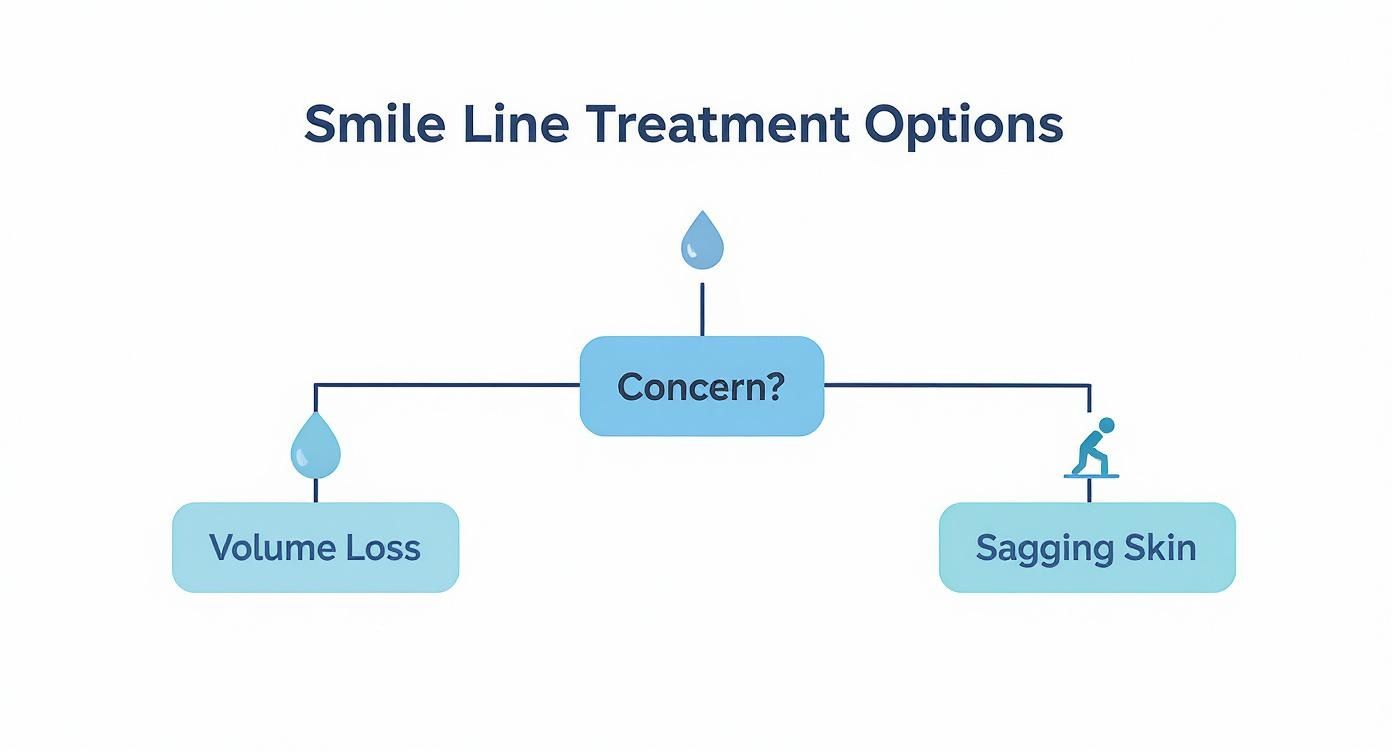
As the flowchart shows, the right treatment path depends entirely on the root cause of the fold. That’s precisely why a personalised assessment is non-negotiable. At Roop Aesthetic Clinic, we make this in-depth analysis our priority, ensuring every client gets a plan that delivers beautiful, natural-looking results.
Understanding Costs, Risks, and Aftercare in the UK

Before you book any treatment, it's vital to get a clear picture of what's involved—from the investment to the recovery. Let's break down the practical side of things.
In the UK, you can generally expect the cost of dermal filler for smile lines to start from around £250 to £400 per syringe.
Of course, the final price tag will shift based on the specific type of filler we use, how much is needed to get the job done right, and the practitioner’s experience. A proper consultation here at Roop Aesthetic is the only way to get a precise, personalised quote.
Potential Risks and Side Effects
Dermal fillers have an excellent safety record, especially when they’re in the hands of a qualified medical professional. Still, it’s important to know what to expect. Most side effects are minor and short-lived.
Common and minor issues include:
- Bruising and Swelling: A bit of localised swelling or bruising right at the injection sites is totally normal. It usually settles down within a few days.
- Tenderness: The treated area might feel a little sensitive to the touch for a day or two.
- Redness: You might notice some mild redness where the needle went in, but this fades quickly.
Serious complications like infection or vascular occlusion (a blocked blood vessel) are very rare. This is exactly why choosing a medically qualified injector who has an expert understanding of facial anatomy isn't just a good idea—it's non-negotiable for your safety.
Interestingly, statistics from the UK show that roughly 28.3% of all dermal filler procedures are performed to treat nasolabial folds. This highlights just how popular this treatment is and why maintaining professional standards is so critical.
Your Aftercare Checklist
Following a few simple aftercare steps is your secret weapon for a smooth recovery and stunning results. Good aftercare helps the filler settle in beautifully and keeps any potential issues at bay.
Aftercare Golden Rule: For the first 24 to 48 hours, treat the area gently. The goal is to let the filler integrate with your tissue without any fuss.
Here's a quick checklist to guide you:
- Avoid Strenuous Exercise: Give it a rest for at least 24 hours to help minimise swelling.
- Steer Clear of Heat: That means no saunas, steam rooms, or intense sun exposure for 48 hours.
- Don't Touch: Resist the urge to rub or massage the area unless we've specifically told you to.
- Stay Hydrated: Drinking plenty of water is great for your skin and supports the healing process.
For a more in-depth look at recovery, have a read of our article on preparation and aftercare for aesthetic treatments.
Your Questions About Smile Line Treatments, Answered
To wrap things up, let's tackle a few of the most common questions we hear from clients who are thinking about treating their smile lines.
Can I Get Botox and Fillers at the Same Time for My Smile Lines?
Yes, but it’s a very specific technique reserved for certain cases. Think of it this way: dermal fillers are doing all the heavy lifting by adding back lost volume directly into the fold. However, for some people, a tiny, precise amount of Botox can be placed near the nose to relax a muscle that pulls the top lip up too high when they smile.
This can help the fold look a little softer, but it’s more of a finishing touch. The filler is always the main event for nasolabial folds.
How Much Do Nasolabial Fold Filler Injections Hurt?
We prioritise your comfort, and honestly, most of our clients find the treatment very manageable. It’s more of a slight pinch than anything else.
This is because we use high-quality dermal fillers that come pre-mixed with a local anaesthetic, and we also apply a strong topical numbing cream to the area before we even begin. The whole process is designed to be as comfortable as possible.
Will I Look Puffy or Unnatural After Filler?
This is probably the biggest fear we hear, but it’s completely avoidable when you’re in the right hands. That dreaded "puffy" or overdone look is a direct result of too much filler being used, or the product being placed in the wrong spot.
The goal of a skilled practitioner is always to create a refreshed, natural look—not an overfilled one. A conservative approach, using just enough product to soften the folds and restore facial harmony, is the key to beautiful results.
Your final result comes down to the injector's skill, experience, and artistic eye. This is exactly why choosing a medically qualified expert at an established clinic like ours is so important for getting a result you’ll love.
Ready to see what a personalised plan for your smile lines could look like? The experts at Roop Aesthetic Clinic are here to give you an honest, professional consultation. Book your appointment online today and let’s explore how we can help you achieve refreshed, natural-looking results.
Article created using Outrank